

'Don't You Forget About Me'. Don't overlook the Older Shopper

They may not ask for attention, but ignoring or stereotyping them has implications

Silver Surfers, Golden Oldies, Boomers, Digital Seniors, Second Lifers, Empty Nesters - each label carries its own baggage. Language matters. It shapes and quietly limits how we design for, communicate with and prioritise this complex, but sometimes overlooked group. Their experiences, priorities, health, digital confidence, income and lifestyles can diverge dramatically and far more than within younger generations.
Defining who qualifies as “older” isn’t straightforward. Post-retirement age captures almost one in five people in the UK. This group spans around 30 years and two generations, the Baby Boomer and Silent Generation cohorts. Some grew up in the post-war rationing era, whilst others had their teenage and early adult years shaped by the 1970s and early 1980’s. Age alone doesn’t define needs, motivations, or value, life stage and the experience gathered on the way does.

Treating “older customers” as a single, homogeneous group, risks missing the nuances that drive engagement, product/retailer choice and loyalty. Understand the detail within and we can capture the potential growth that sits, often untapped, within this one fifth of the population.
Keep older shoppers in the brief: They may experiment less, but they’re not against change.
Reframe innovation; Credible improvements, meeting real needs, within familiar categories rather than trend‑led disruption.
Protect and grow core categories: Double down categories where older shoppers over‑index and loyalty is strongest.
Remove friction, don’t just add excitement: Easier not just faster or flashier.
Generation X: The Pivot Point
Looking to the future, Generation X (roughly spanning 46 – 60 years) are the next cohort to enter this ‘older’ bracket and mark a clear transition between younger and older. They also include people living very different lives: from those still juggling school runs, exams, teenage emotions, mortgages and career pressures to others entering a more settled phase with adult children who have left (and often returned) home, mature careers, more predictable incomes and attention turning to the next chapter.
Our latest WindowOn research shows an attitudinal and behavioural pivot point within Generation X, where food choices and shopping behaviours begin to shift. They blend habits from younger and older shoppers, making them critical to understand, not just for now, but for what they signal about future ‘older’ behaviour.
Channel Use: Loyalty vs Fragmentation
Physical store use remains universal across all age groups, but the attention of ‘older’ shoppers is less diverted by other channels; they under-index in use of online delivery, click and collect, Q-Com, D2C and meal kits.

This channel loyalty shouldn’t be taken for granted, it should be recognised and rewarded. Store environments, customer service, merchandising, promotions and POS are often designed with the younger, not older, shopper in mind; winning with Gen Z shoppers shouldn’t happen at the expense of others. Older shoppers will take note of retailers who design clearly, accessibly and respectfully; messages that feel relevant, font size, style and colour that can be read and prioritising calm layouts and helpful staff over those focused on speed or novelty.
Slow Shopping: Creating an environment for human interactions

Slow Shopping, is a great example of a practical inclusion movement creating welcoming, calmer places for anyone who needs a little more time and space to shop with confidence. It began in response to the needs of older shoppers, including people living with dementia, but benefits many others too, including people experiencing anxiety, those who find busy environments overwhelming, people with communication or literacy challenges and those with visible, invisible or learning disabilities.
Slow Shopping encourages organisations to offer regular weekly afternoon sessions where background noise is reduced, more seating is available and staff are supported to engage patiently and positively with customers. This is not about creating silence, but about creating the conditions where human interactions can flourish.
As Katherine Vero, CEO and Founder of Slow Shopping says ‘When that happens, something shifts. Not only socially, but economically too’.
Online isn't the barrier, relevance might be
Older shoppers are digital pragmatists; they are highly capable, but selective users of online services, focusing on those that offer true value to them.
Online grocery delivery provides this meaningful reward. Many older shoppers adopted online shopping during the Covid-19 pandemic, and a meaningful group remain, around 1 in 4 over 75yr olds. Just as with all age groups, the opportunity lies in a relevant and usable UX with clear, uncluttered, effective thumbnails and targeted messages, but it is even more important as we age.
Click and Collect, Q-com and D2C appear to fail to offer rewards that older shoppers value. Faster wish fulfilment alone doesn’t appear to be compelling.
Meal Kits also significantly under-index amongst older shoppers; 15% of over 50 year olds use monthly vs almost 1 in 2 of those under 40 yrs. Despite seeming to be closer to providing a relevant ‘extra’ incentive with a focus on fresh, quality ingredients and meal inspiration, meal kits haven’t yet cut through well-established habits. Whether this is driven by lower awareness, cost or something more fundamental in the ‘offer’ demands further exploration.
Against expectations, older shoppers are significantly less likely than those 40 years or younger to get additional help. They are not handing over responsibility, continuing to visit stores and make their choice. It may even be older shoppers supporting younger ones tighter on time, energy or money.
Universal Behaviour Across Ages
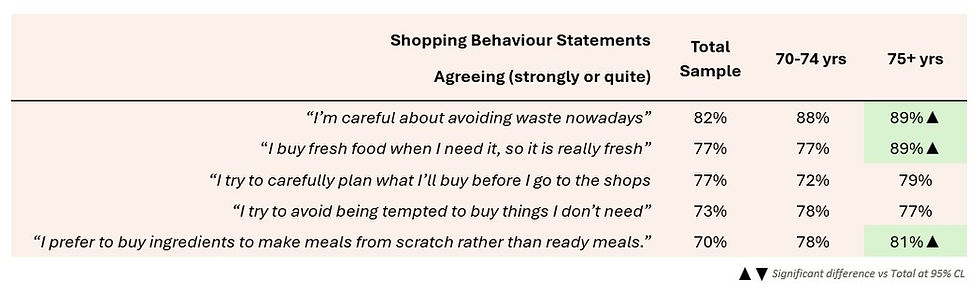
Across generations, freshness, waste reduction, planning, restraint and scratch cooking are universal behavioural anchors. These shared priorities underpin propositions for all shoppers, young and old, growing in importance for the very oldest group – those over 75 years.
Experience Sharpens the Value Equation
With age comes experience and discernment. Older shoppers are less impulsive and more deliberate about how to spend, when it’s worth trading up, trading down or investing time. They keep their retail options open and are more comfortable using discounters than younger shoppers; they trust their judgement to decide what is or isn’t worth paying for. In part, this explains why the cost of groceries causes less anxiety amongst older shoppers.

But willingness to shop around for the best deals declines with age. This might be reduced need or desire, or greater loyalty or routine in where they shop. The store and retailer full offer trumps ad hoc promotional brand activity. Great news for retailers, less so for brands seeking targeted boosts to a retailer’s category penetration.

Innovation: meaningful not superficial
Brands have to work harder to grab attention and change behaviour of older shoppers. There is a sense of ‘been there, done that’. But whilst interest in ‘new’ declines, it doesn’t disappear. Around half those in their 60s and two in five in their 70s still enjoy trying new cuisines and flavour. Less than amongst the younger groups, but still meaningful. Alongside this, ‘quality’ trade ups are harder to win, particularly during older family and early empty nester (or not) life stages. There is a glimmer of hope amongst the septuagenarians who begin to re-engage.

This is not an outright rejection of change; it’s just a signal that getting the proposition right matters more than ever. Success comes from credible improvements, not chasing (or creating) trends. There is a current focus on food nostalgia (new-stalgia if M&S, nosh-stalgia if Waitrose) – whether this is targeting the older or younger shopper remains to be seen.

Older Shoppers Provide Category Stability
It’s important to recognise that older shoppers provide stability in core categories. Penetration within fresh fruit, vegetables, dairy, bakery, meat and fish rises steadily with age. Fresh fruit & vegetables achieve a 95% monthly penetration for the oldest (+75yrs) shoppers vs 75% of all shoppers.

Some ambient and convenient-led categories also perform more strongly with older shoppers, though not to the same degree as fresh staples; biscuits, savoury snacks, cooking sauces and ingredients (and soft drinks for Gen X). Within these categories, there needs to be a concerted focus on building and maintaining Gen X interest, securing the middle ground now, for future category stability.

Food Trend Disengagement
It’s clear, older shoppers are highly intentional. Winning their share of spend means delivering credible improvements, solving real, not ‘created’ problems. Think about pack format and size, convenient cuts, quality reassurance and sauces that simplify the process as well as introduce new flavours and cuisines.
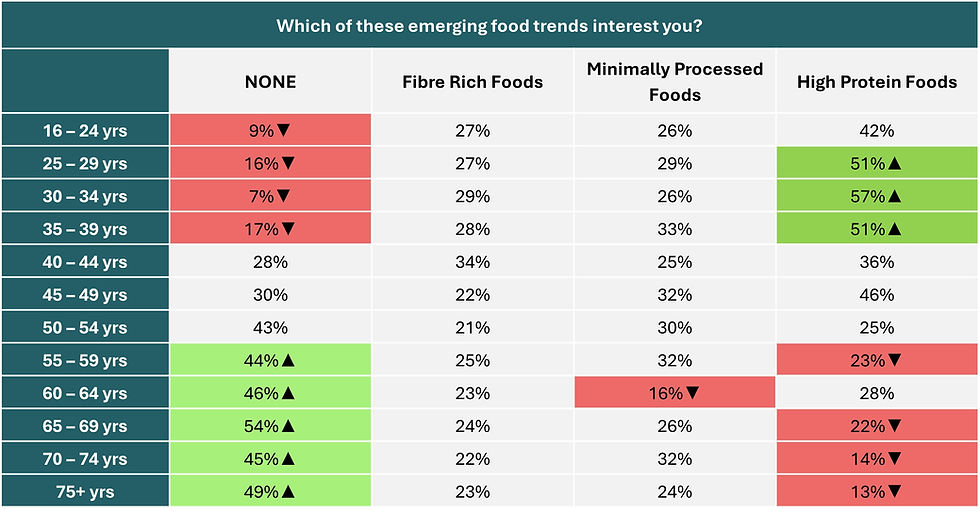
Current health trends aren’t necessarily the way forward with older shoppers. Interest in minimally processed foods and fibre-rich foods DO cut across all ages, but many older shoppers disengage from emerging trends altogether. They are more focused on meeting their nutritional needs through whole foods, rather than supplements, Free From or Plant Based ranges. We mustn’t forget to talk about the health benefits naturally engrained in their preferred categories, rather than layering on more.
This pragmatism is reflected in attitudes to pricing around sustainable, or local options. Lower willingness to ‘pay’ for sustainability doesn’t necessarily signal disengagement, it could just be greater discernment. Some may feel they already make responsible choices and don’t need these discretionary add‑ons or prompts to convert at the point of purchase. Of course, we mustn’t dismiss the converse explanation that as we age, we simply worry less about future sustainability issues.

Older Shoppers worry less
The good news is older shoppers are less easily overwhelmed; anxiety reduces with age. They aren’t entirely worry free, but there are fewer things they are extremely or very anxious about.

Perhaps against expectations, older shoppers are significantly less likely to be concerned by the cost of rates/bills, the cost of shopping and isolation. This doesn’t mean initiatives like Chatty Cafés aren’t important or needed, it’s just people reflect on their situation differently. For the oldest group (over 75 years), only three issues cause more than 1 in 3 to be extremely or very anxious - immigration, the political situation in the UK and the political situation in Ukraine (as recorded in December 2025).

Accessibility is a Growth Strategy, not a niche.
Mental health may be less of a dominant concern amongst older shoppers, but we shouldn’t shy away from acknowledging that age brings greater physical challenges. It’s not until shoppers reach 75 years, that they start identifying these changes as a disability, particularly in four main areas - mobility, continence, communication (speech, hearing and eyesight) and physical coordination.

Designing for this new reality can improve the experience for everyone. Delivering purposeful improvements via clear packs, products, accessible stores and intuitive and simple online experiences should be baked into corporate objectives that everyone, whatever age, understands, buys into and follows.
Authenticity not Tokenism
Older shoppers will spot performative gestures and call out anything that feels tokenistic. Targeted offers need to deliver genuine value and solve a real problem, rather than just repackage or re-merchandise existing products.
We see this being played out in how the industry responds to the growing public dialogue around perimenopause/menopause (in reality, many years before ‘old’ kicks in). It’s a vital and overdue conversation, that requires sensitivity and credibility; get it wrong and you risk being called out.

Sainsbury’s introduction of a menopause-focused bay, with POS education, featuring products certified with the GenM Tick signals positive intent. Some, ‘target’ shoppers will be welcoming this initiative, others may see less need or desire for a dedicated category like this.
This applies to any attempt to create categories targeting older shoppers. The opportunity is significant, but get it wrong and there is the risk of alienating a substantial group of shoppers.
Forgetting or Ignoring the Older Shopper is the Real Risk; four key takeouts
Winning with older shoppers is about meeting them where they are and doing the fundamentals better than anyone else.
Keep older shoppers in the brief: They may experiment less, but they’re not against change when the proposition feels relevant, reassuring, and respectful of their experience.
Reframe innovation: Focus NPD on credible improvements, meeting real needs, within familiar categories rather than trend‑led disruption. Make benefits clear and genuine and worth the mental “investment.”
Protect and grow core categories: Double down on fresh, dairy, bakery, meat/fish and ambient staples where older shoppers over‑index and loyalty is strongest.
Remove friction, don’t add excitement: Convenience means easier choices, clearer packs, right‑sized formats, and dependable quality, not just faster or flashier.
Please get in contact for more information or to discuss what this means for your brand and/or category. While you're here, other worthwhile reads in this WindowOn edition include deep-dives on GLP-1, and the rise of Low and No alcohol.
Anna Dawson,
Head of Qualitative Research
Assumptions cost money. Understanding behaviour makes it.


Comments