

Blurring the lines: The changing contours of health and wellness


How food, health and science are changing the healthy eating landscape /mindset.
As each year begins, health and wellbeing are top of mind and 2026 is no exception. Food and health advertising is changing fast, with rules around HFSS tightening, and GLP-1 drugs dramatically reshaping consumer behaviour, manufacturers/ brands are looking to find ways to stay relevant and compliant. There’s also a growing trend towards a sustainable lifestyle approach, the ‘unjunking’ of foods, and old health (reactive) making way for new health (preventative).
We asked our panel of UK grocery shoppers which emerging food trends were of most interest; what is their diet preference, which cooking appliances they use, and what changes, if any, they may have made to their cooking or eating habits, and their purchasing of (selected) health and wellness categories.
Emerging Food Trends

The desire for high-protein products continues to attract the most interest (35%), driven by the 18-34s (50%) but high-protein products are still relevant to 20% of those aged 55+. Protein is often viewed as a core element of healthy eating. It’s fairly easy for consumers to switch in, and its popularity has been steadily rising. High-protein categories are evident in many grocery aisles, with affordable options such as Greek yogurt, cottage cheese, nuts, as well as more premium high-protein powders and shakes.
Minimally processed foods/ clean ingredients resonate among our panel (28%), tapping into the trend that consumers are seeking to buy more natural food (closer to how it is grown), without expectations of it being homemade. A growing trend is for more transparency in food labelling, likely to be a backlash to ultra-processed foods and perceptions of factory-made food products. Likewise, for health and wellness products, e.g. Ritual, who are redefining “clean” supplements.
Not far behind, 26% of our shoppers are interested in fibre-rich foods. Protein & fibre messaging is increasingly described as “The New Safe Territory” because UK HFSS ad restrictions are now significantly stricter, with bans on identifiable “less healthy” products on TV before 9pm and paid‑for online ads prohibited entirely. UK NHS guidelines also suggest fibre consumption is below the recommended daily intake (30g a day, most adults average 20g) [1]. High-fibre messaging is not new (cereal, bread brands have and continue to use these claims) but currently they are gaining in mass market appeal.

Fibre-rich foods are one of the pillars of digestive comfort (an evolution in gut health), where consumers seek less bloating, eat more slowly, choose lean proteins, and opt for smaller meals. 10% of our panel is interested in fermented foods, a trend driven by gut health with products such as kefir and home fermentation increasingly popular, as consumers are making their own kimchi, sourdough, kefir among others to boost probiotic intake.
Nutrient-dense alternatives [2] (26%) and fortified foods [3] (16%) also attract lots of interest, driven by weight-management and satiety, and health optimisation. Nutrient dense foods (e.g. lentils, eggs, frozen vegetables) are more accessible, allowing consumers to stay nourished without a premium price tag. Elsewhere in our research, 6 in 10 agree they look out for their gut health, while 1 in 10 are concerned about cholesterol, higher among household with children and ABC1s.
Diets, and Changing Cooking Habits
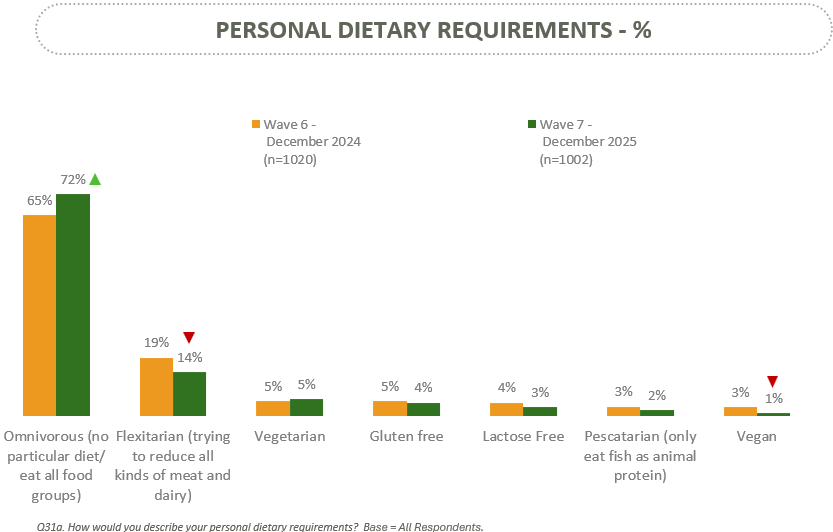
We have been tracking personal dietary requirements/ preference since 2020, and while trends have fluctuated, the proportion of shoppers who identify as omnivores, is at its highest (72%), seeing significant growth since 2024. Likely to be linked to the demand for high-protein diets, animal protein is often favoured by consumers. Conversely there is a significant decline in flexitarians (14% vs, 19%, 2024) and vegans (1% vs. 3%, 2024) and this is a consistent trend across many EU markets which is seeing growth in meat consumption again. While five years ago, sustainability was the main growth driver for the Plant-Based Meat Substitutes (PBMS) category, the decline in public interest in sustainability helps explain why category growth has significantly slowed. It’s a complex issue, as political parties often defend livestock farmers and meat lobbies strongly influence public preferences. New names and phrases used to describe consumer bases are regularly coined by the food and drink sector, and open-omnivore is the latest to emerge. Open-omnivores are likened to omnivores open to eating plant-based meats but haven’t done so yet; seen as a new way to drive interest in plant-based categories. [4]
Cooking Habits

Turning now to how cooking habits are changing. Cooking from scratch, buying frozen foods, skipping meals, home-baking, using meal kits all see a net rise, but buying ready meals, eating sandwiches at lunchtime, getting takeaways/ deliveries have waned.
“Cooking from scratch” could be subjective: some may define it as using only raw ingredients (e.g. making pasta from scratch), while others might include assembling meals from ready‑prepared components (e.g. prepared chopped vegetables). Given that the average time spent making dinner in the UK is under 32 minutes, shoppers/ consumers will be reaching for short cuts while at the same time wanting to produce healthy meals. [5]
Appliance Ownership
This desire for heathy convenience reflects the type of cooking appliances people have and use in their homes. Microwaves dominate ownership at 82%, which isn’t shocking—they’re a long‑established kitchen staple. While air fryers rank fourth (61%), they are punching above their weight on usage suggesting a shift in how people cook day‑to‑day: quick, convenient, and “health‑adjacent” methods are winning. Microwaves remain ubiquitous, but the air fryer is clearly becoming the workhorse in many kitchens. Slow cooker ownership is more modest, averages 45%, reflecting their more niche, meal‑planning‑oriented role.

Reflecting changing food cooking and prep in home behaviours, food manufacturers are merchandising to illustrate appliance compatibility and endorsement, with on pack messaging and pack visuals, given that packaging is often the critical, primary brand touchpoint and a trust building tool that extends beyond the product itself.

[6] Recommended by Ninja® for crisp and golden fries every time! The No.1 air fryer brand*
*UK 3rd party market data, sales by volume (Jan '24 - Dec '24)
Health and wellness category purchasing in the last month.
The demand for healthier eating means that consumers look beyond food to broader health and wellness categories.

Among the Health and Wellness categories tracked, penetration increased across all categories and channels vs. 2024. Subgroup differences emerge among in‑store shoppers: 25-44s drive health & beauty; 25-34s, ABC1s drive health/ nutritional supplements, 18–34s and parents lead sports supplements and sexual wellbeing. Among, on‑line shoppers, households with kids, and 25–34s lean toward health & beauty, health/ nutritional supplements and sexual wellbeing products, with 25–34s also favouring sports supplements. GLP1 users are significantly higher on health and nutrition supplements (36%).

Channel choice also sees growth in Pharmacy (in person), likely linked to growing awareness of Pharmacy First, direct from a brand website (10%), is static vs. last year, but figures are twice as high among 18-24s (19%); similarly, social media / commerce is static (8%) but much higher among 25-34s (19%) and both are higher among parents (c.16%).
Reasons to use social media
There are no major differences on social media usage, year on year, but more people are turning away from social and disconnecting from phones, which could be a sign of “digital detoxing” as people try to improve their mental health and regain control of time and attention (led by 55+).

AI in providing medical advice currently triggers more concern than excitement, especially among women and older shoppers, while affluent ABC1s lean into the opportunity — a gap driven by exposure to AI, tech and digital confidence, and one that will evolve as real‑world benefits become visible. People instinctively treat health as high stakes, and with early-stage emerging technology trust builds slowly, as technology proves reliable, the user feels in control and the system supports clinicians rather than replacing them.

To round up, there is a growing focus on healthy lifestyle habits in the UK, in food and beverage. Retailers are already responding to the transformative impact of new weight loss meds, in adapting their ranges, portion sizes, messaging and we will be keeping a close eye on the impact of GLP-1 and how it unfolds, alongside other significant trends (e.g. UK government commitment to regenerative farming, and how grocery supermarkets continually strive for competitive advantage). [7]

For Health and wellness, the boundary between medicinal/clinical products and the mass-market consumer sector continues to blur, driven by a "clinical confidence" trend where consumers seek science-backed, products in everyday retail channels (e.g. Ritual[8]), widespread use of at-home health monitoring (DNA/wearables), and a focus on holistic "emotional fitness". Industry shifts for 2026 are predicted to include gut-brain connections (proteins that could repair the gut-brain link to ease depression); oral microbiome: a new focus on the health of the mouth and its connection to overall wellbeing. Direct to consumer (DTC) for health products, supplements, prescription pharmaceuticals continue to grow, as does subscriptions and product personalisation.
Several notable brands

What this means for brands and shoppers in 2026
The healthy eating landscape isn't just shifting, as we can see, it's accelerating. As always, the brands that plan ahead are most likely to stay relevant and drive new growth.
Four things we expect to see more of:
Science Moving to the Shelf
As more clinical-grade nutrition is entering everyday retail, the boundary between pharmacy and grocery will keep blurring and consumer expectations for science-backed credentials are likely to rise. Brands like Ritual are already setting the bar.
Personalisation at Scale and Channel Matters
DNA testing, wearables and AI-driven recommendations are making one-size-fits-all feel obsolete. DTC, subscription models and product personalisation are all growing. Understanding ‘where’ shoppers are being influenced and where they're buying, matters as much as product strategy.
The Omnivore Resurgence
As we have seen, flexitarianism is retreating and protein demand is surging, plant-based brands may need to drive a fresh narrative. Meanwhile, fibre and gut health offer the clearest growth for mainstream food and drink. These are credible, natural and in-demand.
It’s not just about GLP-1
Smaller portions, nutrient density and satiety do not sit in the sole domain of attempting weight loss through whatever means. These factors are becoming more mainstream consumer choices, which the shopper needs to readily access.
Health and wellness is no longer a category in isolation. It's shaping the context in which food and drink decisions are being made. Brands that recognise these trends and execute with genuine authenticity will be best placed to make the most of them.
Please get in contact for more information or to discuss what this means for your brand and/or category. While you're here, other worthwhile reads in this WindowOn edition include deep-dives on GLP-1, and the rise of Low and No alcohol: both heavily linked to the overall topic of healthy living.
Marie Screene,
Head of Quantitative Research
Assumptions cost money. Understanding behaviour makes it.

References
[2] Foods that are lower in calories but high in fibre and protein, which helps people feel fuller for longer
[3] Fortified with vitamins, mineral and supplements necessary for optimal health


Comments